Santa's Woods
3764 State Highway 133
Blair, NE 68008
(402) 426-5250
Christmas is a time of Celebration
with Friends and Family.
Begin a new tradition and build memories
for generations to come at Santa’s Woods!
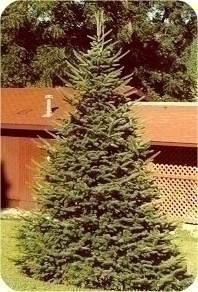
Canaan Fir
Canaan (pronounced "Ka-naan", with emphasis on the last syllable) is a relative newcomer to the Christmas tree market. It has many similarities to both Fraser and balsam firs in growth and appearance. Unfortunately, this similarity which has led to a great deal of confusion.
In 1909, a variety of balsam fir was described in the literature as having cone scales extending from the bracts. This morphology was a deviation from typical balsam fir cones where the scales are not extended. This variety was then named "phanerolepis" which actually means conspicuous scales. The scientific name of Abies balsamea var. phanerolepis was assigned. The common names most often used were "bracted balsam fir" and "Blue Ridge fir". Canaan fir had not, at that time, been described separately.
Where does Canaan fir fit into the scheme?
Canaan fir is so-named because several of the original trees with the intermediate morphology were identified from a limited area in West Virginia, generally referred to as the Canaan Valley. Taxonomically, Canaan fir is considered the same as bracted balsam fir and has the scientific name of Abies balsamea var. phanerolepis. However, growth traits of the trees from these southern regions are somewhat different than for other bracted balsam fir. Thus, there occurs a dilemma as to how Canaan fir should be classified. There are lots of opinions. The simplest solution is probably to consider Canaan fir as a special ecotype of bracted balsam fir; this ecotype having unique characteristics as a result of the environment to which it has been exposed. It is not currently considered a separate species.
And don't forget the tree stand.
Click here for the best tree stand in the world; made right here in Nebraska.
It will be the last stand you ever buy.
We have all types of Christmas Trees, including Grand Champions!
Canaan Fir Concolor Fir (White Fir) 2006 State Fair Grand Champion! Douglas Fir 2008 State Fair Grand Champion! Fraser Fir (Frazer Fir, Frasier Fir) 2007 State Fair Grand Champion! Scotch Pine White Pine (Eastern White Pine)Photo courtesy of National Christmas Tree Association. Excerpted from NCTA information prepared by Dr. Craig R. McKinley, North Carolina State University